The Human Signature: Why Imperfection Matters in an Age of AI

Mike Curphey • July 17, 2026
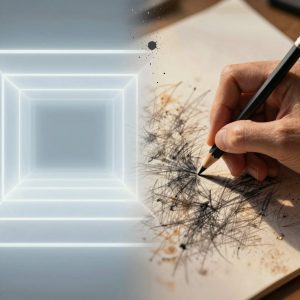
The Short Version: AI is getting really good at making things that look and sound perfect. But perfection is boring. The essay argues that what makes art and creativity valuable isn’t just the final product—it’s the human effort, mistakes, and unique perspective behind it. AI can copy the style, but it can’t copy the soul or the experience of creating. So, instead of fighting AI, use it as a tool, but keep doing the messy, slow, human work yourself. That’s where your real value lies.
The “Why Should I Care?” Breakdown:
- Perfection is Empty: AI can write an essay or draw a picture in seconds that is technically flawless. But it feels hollow because it wasn’t made by someone who actually lived through the process of making it.
- The “Vibe” is Human: Think about live music vs. a studio recording. The studio version is perfect, but the live show has energy, sweat, and mistakes that make it feel real. Same with art: seeing the brushstrokes or hearing the breath in a singer’s voice connects you to them as a person.
- Your “Glitch” is Your Superpower: AI doesn’t have feelings, fatigue, or personal history. Your unique way of doing things—even your mistakes or hesitations—is what makes your work yours. AI can mimic the style, but it can’t mimic you.
- Use AI, Don’t Fear It: AI is great for brainstorming or getting unstuck. But don’t let it replace your own thinking and creating. The more you lean into slow, thoughtful, human creation, the more unique and valuable your work becomes.
The Takeaway: Don’t try to compete with AI on speed or perfection. Compete on humanity. Your experiences, your struggles, and your unique voice are things AI can never replicate. Embrace the messy, slow, human part of creating—that’s where your power is.
Full Version:
It is undeniably convenient. With a single prompt, AI can draft an essay, generate a photorealistic image, or compose a symphony in seconds. The output is fast, clean, and technically “correct.” But if you’ve ever stared at a perfectly rendered digital image or listened to a flawless AI-generated melody, you might have felt a strange emptiness. It feels hollow. Why? Because that image has no muscle memory, and that song has no heartbeat. In a world where we can have anything instantly, the value of presence is becoming the ultimate luxury. Beauty is no longer just about decoration; it is the evidence of a human mind wrestling with reality.
Consider the difference between typing and writing. AI text is uniform; every “e” is identical, stripped of personality. Calligraphy, however, is kinesthetic. It is an artistic discipline meant for beautiful lettering, but more importantly, it is movement. Think of it like the difference between listening to a polished, auto-tuned pop track on Spotify versus standing in the front row of a live concert. The recording is technically perfect—every note is in tune, every beat is precise—but it lacks the raw, visceral energy of the moment. A live performance has weight; you can feel the vibration of the bass in your chest, see the sweat on the singer’s brow, and sense the tension in the air. That physical effort is what makes it real. Learning calligraphy forces your brain to slow down. It connects your hand to your mind. In a world of endless scrolling, these practices demand presence. They are physical anchors in a digital storm.
Think about the last time you watched a friend learn a difficult TikTok dance or nail a complex guitar riff. You didn’t just see the final move; you saw the hours of practice, the frustration, and the eventual triumph. That’s the difference between AI art and human art. When you look at a masterpiece, you aren’t just seeing pixels or paint; you’re seeing someone else’s time and effort frozen in place. AI can copy the style of a brushstroke or a chord progression instantly, but it has no memory of the struggle it took to get there. It has no fatigue, no joy, and no lived experience. It can replicate the output, but it can’t share the life behind it. That’s why a hand-drawn sketch or a raw, unedited voice hits different—it’s proof that a real person was there, feeling, trying, and creating.
Music offers a profound lesson here. It is an art form that relies on the tension between sound and silence to create meaning. AI can generate a polished track in seconds, but it doesn’t understand that the beauty often lies in the effort required to play it. Think about the difference between a perfectly quantized digital beat and a live drummer where the snare hits slightly off-beat. That slight human error isn’t a mistake; it’s the “groove.” It’s the feeling of someone actually sitting behind the kit, breathing, and pushing the rhythm. When you learn an instrument, even just the basics, you realize that the struggle of mastering a chord progression or singing a melody is where the connection happens. The “signature” in your performance—the slight hesitation, the breath, the unique timbre of your voice—is not a bug. It is the signature of your humanity.
We don’t need to reject technology; we need to balance it. AI is incredibly helpful for brainstorming, organizing research, or generating rough drafts. It can help you find the words when you’re stuck or suggest a chord progression you hadn’t considered. But here is the catch: AI has no taste. It can mimic style, but it cannot decide what is good. It doesn’t know what feels right, what resonates emotionally, or what connects with an audience. It lacks the soul that comes from lived experience. In an age of mass production, you are the limited edition. Your ability to feel, to struggle, to create slowly, and to curate the final product is your superpower. This isn’t about being “old-fashioned”; it’s about reclaiming your agency. Recognizing that you have the power to shape your own future through intentional decisions is a rebellion against the speed that tries to flatten you into data. AI can give you the answer, but only you can give the question meaning.
Embrace the slowness. Embrace the variance. That is where your power lies.