Beyond the Rubric: Why Learning the Piano is the Ultimate Training Ground for the AI Economy

Mike Curphey • July 10, 2026
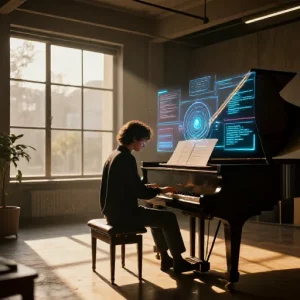
am sitting at my piano. I am not trying to become a concert pianist. I am trying to understand how to remain relevant in an economy where machines can compose symphonies, generate code, and draft legal briefs in seconds.
The prevailing anxiety is that AI is coming for our jobs. But the more insightful experts argue that the threat isn’t just about execution—it’s about value. As AI commoditizes routine, defined work, human value shifts to three specific areas: navigating ambiguity, exercising judgment (taste), and building trust through proof of work.
For years, I viewed learning the piano as a leisure activity. I now view it as a rigorous, high-stakes simulation of the future professional landscape. Here is how the discipline of music addresses the exact skills needed to thrive in the AI age, stripped of the romantic fluff.
1. Navigating Ambiguity: The End of the Rubric
In traditional education and early corporate structures, we were trained to solve problems with rubrics: clear inputs, known variables, and a single “correct” output. AI excels at this. It is the ultimate rubric-solver.
However, the real world is messy. It involves vague goals, conflicting stakeholder desires, incomplete data, and artificial deadlines.
When you sit down to play a piece you have never seen before, there is no rubric. There is no “correct” way to interpret the phrasing of a Chopin nocturne until you decide. You must make hundreds of micro-decisions in real-time: Do I linger here? Do I push the transition? Does this chord feel heavy or light?
This is not just “artistic freedom”; it is ambiguity navigation. You are holding conflicting desires (the melody wants to soar; the harmony wants to ground) and resolving them under the pressure of performance. This is the exact cognitive muscle required when facing a business problem with no clear dataset or a client whose goals contradict your own. You learn to act decisively without complete information. That is a skill AI cannot replicate because AI requires defined parameters to function.
2. Cultivating Taste: Judgment Over Execution
The second skill is Taste. In an era where anyone can generate technically perfect output for free, value shifts to judgment. You must be able to look at AI output and decide if it is actually “good,” if it understands the “point,” or if it has true market fit.
How do you develop this taste? You cannot prompt your way into it. You develop it by spending time with high-quality work and understanding the mechanics behind it.
Learning piano forces you to distinguish between mechanical accuracy and expressive impact. You hear the difference between a recording that is technically flawless and a performance that moves an audience. You learn that a slight delay in a phrase—a “human” error—can make the difference between a boring recital and a moving experience.
In the AI age, everyone will have access to the tool. The winner will be the one who can say, “No, that’s technically correct, but it’s dead. It lacks the human nuance. Let’s try it this way.” Your years of listening and practicing are training your ear to detect the “essence” of a piece of work. This is strategic judgment, not just aesthetic preference. It is the ability to evaluate utility and impact, which is critical for any leader in the AI age.
3. Building Reputation: Proof of Work in a World of Prompts
The third skill is building a Reputation based on Proof of Work. In an economy where everyone has tools and everyone produces output, trust cannot be prompted. You must build a brand based on people watching you do real work.
Playing the piano is inherently performative. You cannot fake the hours. When you share your journey—your struggles, your breakthroughs, your public performances—you are building a brand based on tangible, observable effort.
AI can write a blog post about your piano practice. It can even generate a video of hands playing. But it cannot replicate the narrative of growth. People trust people who show up, who break things, and who fix them. By documenting your musical journey, you are demonstrating the very work ethic that AI cannot mimic: the sustained, deliberate practice that leads to mastery. This is your “proof of work.” It signals to the world that you have the discipline to master a complex system, a trait that translates directly to professional trust.
The “One-Person” Studio: Building vs. Waiting
The experts advise us to focus on Building vs. Waiting. They suggest that self-taught, practical education (“pick something real, build it, break it, fix it, ship it”) is more valuable than traditional degrees, which train people to solve problems with rubrics—the exact type of work machines now do for free.
Learning to play the piano is the ultimate “self-taught, practical” loop. You pick a piece (a real problem), you try to play it (build), you make mistakes (break), you adjust your technique (fix), and you perform it (ship). You are not waiting for a professor to grade you. You are acting as the composer, the performer, and the critic.
This mirrors the future of work: the “One-Person” Startup. You are using APIs (your brain, your hands, your ears) as your employees. You are leveraging technology to amplify your individual capacity, not replace it. The leverage for the future lies in individuals who can act like a whole team. The pianist who can compose, arrange, perform, and market their music is a prototype of this future independent professional.
Guard Your Scarcity: Outlast, Don’t Out-Grind
Finally, we must Guard Our Scarcity. Knowledge is being commoditized, but time and attention are the new scarce resources. The advice is clear: Outlast, Don’t Out-Grind.
You cannot win by working harder or longer. Don’t try to “out-grind the damn machine.” AI doesn’t sleep. It doesn’t get tired.
Learning piano teaches you the value of sustainable practice. You cannot cram a Beethoven sonata. You must build a relationship with the instrument over years. You must prioritize rest, recovery, and mental clarity. In a world that glorifies hustle culture, the pianist knows that burnout leads to injury and loss of skill. By maintaining a healthy life and a balanced practice routine, you are protecting your most scarce resource: your longevity. You are choosing to be in the game for the long haul, while others burn out trying to keep up with the speed of the machine.
Conclusion: The Human Edge
I didn’t just practice technique today. I practiced ambiguity. I refined my taste. I built my reputation through practice. I worked like a one-person studio. And I protected my time by knowing when to stop.
The piano isn’t just a hobby. It’s a training ground for the human skills that AI can’t touch. And in the years to come, those skills will be the only things that matter.